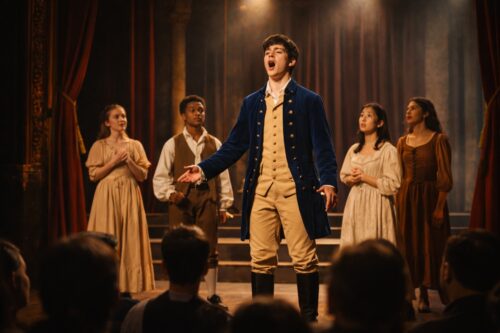
For a long time, theatre was the default path for creative kids. Drama club, school plays, musical theatre programs, summer camps, auditions. If your child liked performing, that was the lane. Get on stage, learn your lines, sing the songs, hope you get cast.
But something has been changing.
More and more parents are starting to look at music instead of theatre as the main creative path for their kids. Not because theatre is bad, but because the world around it has changed.
Theatre, at its core, is about performance. You’re stepping into someone else’s story. Someone else wrote the script. Someone else directs the show. Someone else decides who gets the role. Even if you’re talented, you’re still waiting to be chosen.
Music works in the opposite direction. It’s about creation first. You write the song. You shape the sound. You build the identity. Instead of asking for permission, you’re making something that belongs to you.
That difference might sound subtle, but in today’s world, it’s huge.
Parents aren’t just thinking about talent anymore. They’re thinking about time, money, and long-term opportunity. Theatre takes a lot of investment. Years of classes, expensive programs, constant auditions, and a career path where only a very small percentage of people ever make a real living from it.
Music feels different. Vocal training, songwriting, and production skills don’t disappear after one show. They stack. Every song becomes an asset. Every recording is something you can release, improve, or build on.
From a parent’s point of view, theatre can start to feel like chasing roles, while music feels like building something.
What’s interesting is that schools still push theatre very hard. It fits perfectly into the education system. Group activities, school productions, showcases for parents. It makes sense inside a classroom.
But the real entertainment industry doesn’t run on school systems anymore. It runs on streaming, social media, independent releases, and digital platforms. The biggest opportunities today come from original content, not auditions.
That’s why so many families are slowly shifting away from school-based theatre programs and toward private vocal coaching, songwriting, and artist development. They’re following where the real market is.
And the shift is starting younger than ever.
A ten-year-old today can already do things that were basically impossible when most parents were growing up. They can start vocal lessons and learn how their voice actually works. They can write simple songs instead of just memorizing lines. They can record at home. They can post covers or original music online. They can learn piano or guitar and understand how songs are built from the inside.
At that age, it’s not about being famous. It’s about learning how to create.
By the time that same kid is fifteen or sixteen, they’re not just “trying it out.” They already have years of experience, a catalog of songs, and usually some kind of audience. That kind of head start doesn’t really exist in theatre, where every audition is a reset and every role depends on someone else’s decision.
Theatre has one main path. You audition, you get cast, you perform, and then you start over.
Music has dozens of paths, and they can all happen at the same time. An artist can be writing, recording, releasing, building an audience, performing live, and even licensing music all at once. There’s no single gate and no one moment where someone tells you you’re allowed to begin.
That’s also why the definition of “artist” has changed.
The modern artist isn’t just a performer anymore. They’re a brand. They’re a content creator. They’re a business. They own intellectual property. They think about audience, identity, and long-term value, not just the next show.
Theatre teaches you how to perform.
Music teaches you how to create, build, and own.
This shift isn’t about theatre versus music. It’s about which path actually matches the world we live in now.
The future belongs to artists who own their work, control their audience, and build something they can grow over time. Artists who think like creators instead of applicants.
That’s why more parents are moving their kids toward vocal training, songwriting, and artist development. Not because theatre is disappearing, but because music offers something theatre simply can’t in today’s industry.
Freedom. Scalability. And real creative ownership.
In a digital world, the artist who creates the song holds more power than the artist waiting to be cast in one.
written by Dean Cramer via Kings of A&R
 Newsletter